Personalisation & Decoration: Making the Mark Legible, Not Loud
Recipients want a mark they can read and a gift they are not embarrassed to carry. The two are not in conflict — legibility is not size, and the method you pick decides whether the mark survives real use.
The decoration is where most corporate gift budgets quietly fail. A good product with a badly placed, badly sized or badly executed mark becomes something the recipient uses at home and not in public — which is exactly where the value was supposed to come from. The choice is not really between methods; it is between a mark that is legible and one that is loud.
Why the mark matters more than the merch
There is a tension in the data worth understanding, because it explains most decoration mistakes. On one side, a large minority of recipients want restraint: 44% of consumers in PPAI's 2025 "5-Second Impact" survey say they prefer subtle branding over big, bold logos, and close to 90% say design plays a role in whether they keep a promotional product at all. On the other, the mark still has to work — 57% of respondents in that same survey said a clear and visible logo or brand name is what helped them remember the brand, and 48% said an item personalised with their name, initials or role is more memorable than a generic branded one (PPAI, 2025). Those findings are not contradictory, because legibility is not size. A small, well-contrasted, well-placed mark reads instantly; a large one in tonal thread on a busy fabric does not. Decorated gifts do get remembered, though no study isolates legibility as the reason: 85% of consumers say they recall the advertiser behind a logoed product, at a modelled cost of around six-tenths of a cent per impression, across roughly 5,000 consumers in the US, Canada, Mexico and Europe (ASI, 2026).
Timing starts at artwork approval
Decoration, not the product, is what sets your lead time — and the clock starts when artwork is approved, not when you raise the purchase order. Embroidery adds a one-off digitising step per logo, per size and per placement, so moving the same mark from left chest to cap front is a new charge. Laser engraving on an unfamiliar substrate usually needs a test piece before the run. Each proof revision pushes the schedule back, so build in one round you expect to use, and ask your supplier for the working-day count from approval rather than assuming the product's stock lead time covers it. Approve artwork against the actual product colour, never a white background — contrast is where most sign-offs go wrong.
Which method for which material
- Embroidery — textiles that get washed. Caps, fleeces, polos. It survives repeated laundering, which is what decorated apparel is for. Stitch count rather than print area drives the unit cost, thread has no tonal range so gradients must be redrawn as flat colours, and thread matches approximate a brand Pantone rather than hitting it. Set a minimum text height and avoid fine serifs. An embroidered recycled cotton cap is the standard test of whether your mark works small — see our branded apparel guide for the garments themselves.
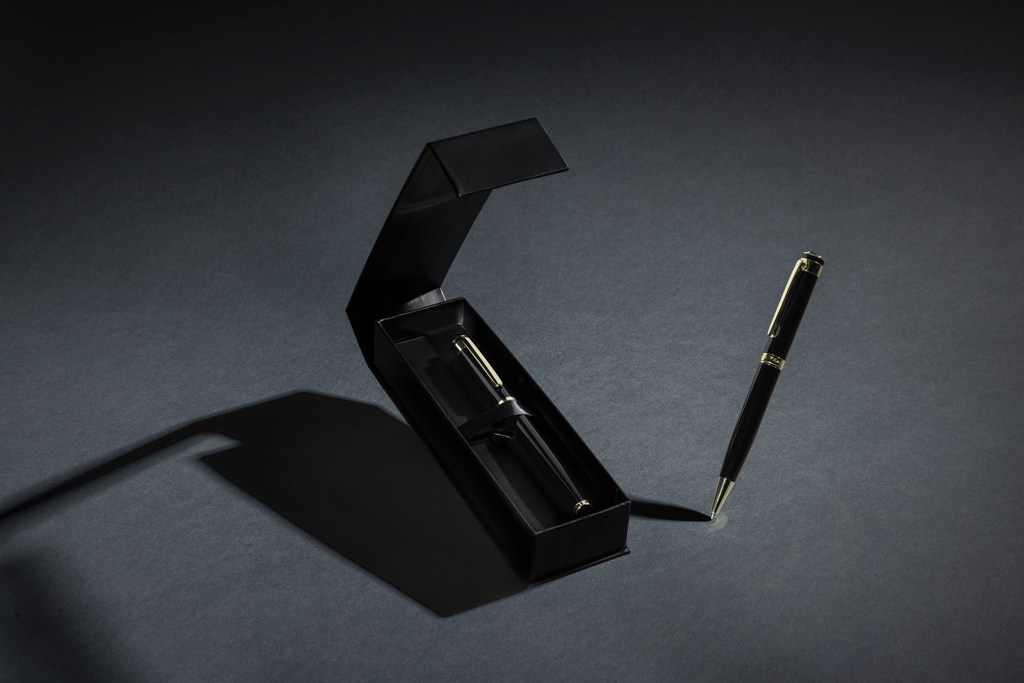
- Laser engraving — metal, wood, bamboo, leather. Permanent, tonal and impossible to peel. It gives contrast rather than colour, so a logo that depends on brand colours will lose them; check a sample. Ideal on an engraved brass pen or an engraved serving set.
- Pad and screen print — hard goods and flat surfaces. Spot colour, low unit cost at volume, less durable under abrasion. One screen or pad per colour, each with its own set-up charge, so a two-colour logo roughly doubles the set-up of a one-colour version — and gradients or photographic artwork need a different process entirely.

What to avoid
Avoid decorating across a seam, a curve or a zip — the mark distorts and the cost rises. Skip full-chest and full-panel prints on anything you want worn outside the office. Avoid heat-applied transfers on garments meant to last, because they crack and lift long before the garment wears out. Do not personalise names onto items you cannot reissue: one misspelling in a batch of 200 is a reprint, not a correction. Never approve artwork from a screen mock-up alone on a textured or dark material. And remember what you are committing to — once artwork is approved, decorated stock is non-cancellable and non-returnable, and suppliers commonly ship a small over- or under-run against the ordered quantity, so order above your headcount rather than exactly to it.
What to ask a supplier before you sign off
Get these in writing. The imprint area in millimetres for your specific product and position. The number of decoration colours included in the quoted price, and the cost of each additional one. Whether digitising or set-up is one-off or repeats per order. The minimum order quantity for that method on that item. A physical pre-production sample for anything above a modest spend. The confirmed lead time in working days from artwork approval. Whether stock is reserved against the quote, and for how long. And if you are handing over recipient names, initials or job titles, a written data-processing agreement under Article 28 GDPR naming what the supplier may do with that list and when it is deleted. None of this is an unusual ask: in PPAI's 2024 survey of its PPAI 100 firms — the largest distributors and suppliers rather than a representative sample — 51% of distributors called customisation "very important" and another 26% "important", and 82% of suppliers said they offer it across a large majority of their range (PPAI, 2024). Separately, confirm you hold the rights to reproduce any third-party logo: permission to use a mark in marketing does not automatically extend to goods, supplier terms normally make the buyer warrant those rights, and an indemnity clause will not stop a rights holder pursuing everyone in the chain.
Legible, not loud
The test for any decoration is simple: could the recipient carry it into a meeting with someone else's client? A small mark with real contrast, placed where it does not fight the product, passes that test — and a mark that passes it gets used, which is the only way a gift earns anything. Browse the catalog for products that decorate well, or contact us and we will help you get the artwork right first time.